
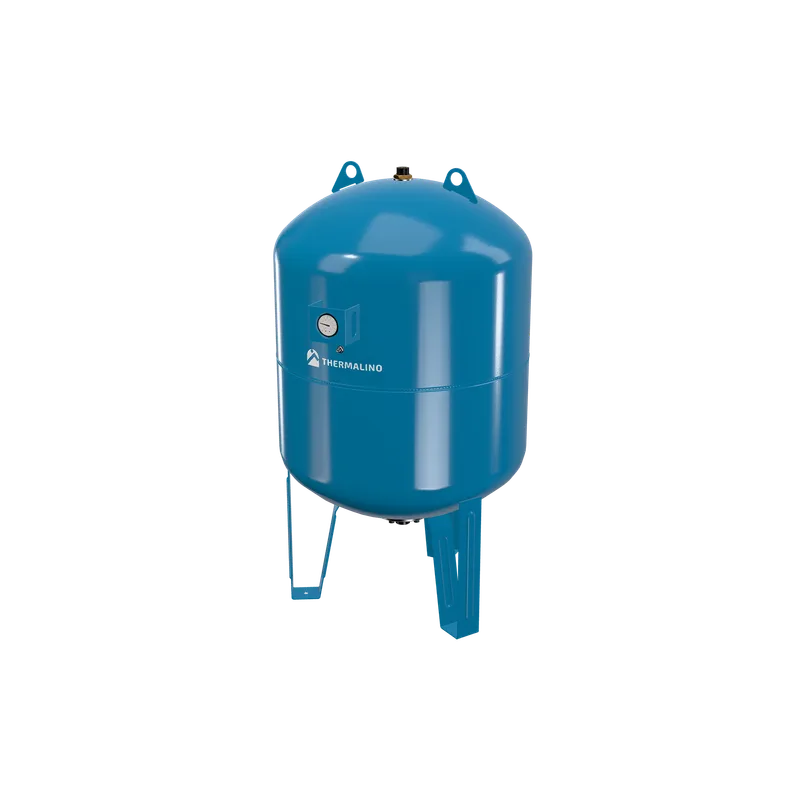
Vertical Floor-standing Potable Water Expansion Vessel With Pressure Gauge
The vessel is supplied pre-charged with nitrogen, but the correct pre-charge depends on the pump cut-in pressure of each system. The installer checks and adjusts it with the water side empty and unpressurised before commissioning, as a wrong pre-charge is a common cause of pump cycling.
Images
Description and application
This vertical pressure tank for water pump systems stores pressurised drinking water behind a replaceable EPDM membrane, reducing pump starts and keeping supply pressure steady in booster sets and well systems. It is built to EN 13831 for a maximum operating pressure of 10 bar, stands on its own feet, has a pressure gauge fitted and comes in sizes from 100 L to 5000 L.
The Eternal line vertical floor-standing potable water expansion vessel is a pressure tank for water pump installations that carry drinking water. A membrane separates the water from a pre-charged gas cushion: while the pump runs, water is pushed into the vessel and compresses the cushion, and when a tap opens, the stored water is delivered at pressure before the pump has to restart. Fewer starts mean less wear on the pump motor and more even pressure at the outlets. The vessel is built to EN 13831, the European standard for closed expansion vessels with a built-in membrane, and is rated for a maximum operating pressure of 10 bar. The membrane is EPDM of Italian origin and is replaceable, so a worn membrane can be renewed without replacing the vessel. It is supplied pre-charged with nitrogen, which is less prone than air to pass through the membrane, and a pressure gauge is fitted so the pressure can be read directly at the vessel. Sizes run from 100 L to 5000 L. The vessel stands upright on its own feet, so no separate bracket or mounting frame is needed: it is placed on a level floor in the plant room and connected to the pump discharge line, normally with an isolating valve and a drain so it can be serviced. Besides the standard connection, it can be supplied with other connection sizes on request. Before commissioning, the installer sets the pre-charge to suit the pump cut-in pressure. Dimensions, connection sizes and the factory pre-charge for each size are given in the technical data sheet.
- Pressure booster sets for drinking water in residential, office and commercial buildings
- Hotels, hospitals and schools
- Well and borehole pump systems
- Potable water supply in industrial plants and factories
- Irrigation and agricultural water supply, within the 10 bar maximum operating pressure
- Surge and water hammer damping on pumped potable water lines
Technical summary
- SKU
- THL-E-EXV-0003
- Origin
- Made in Türkiye
- Size range
- 100 L – 5000 L
- Application
- Potable water
- Membrane
- EPDM
- Membrane type
- Replaceable
- Max. operating pressure
- 10 bar
- Mounting
- Floor
- Standard
- EN 13831
Questions
- How do I size a vertical pressure tank for a water pump booster set in an apartment building, and is it a problem if it is too big?
- A pressure tank for a water pump is sized from the pump flow rate, the difference between the cut-in and cut-out pressures, the vessel pre-charge and the maximum number of pump starts per hour the motor allows. A vessel larger than the minimum does no harm in itself: it stores more water between starts and reduces cycling further, and the practical limits are floor space, the weight when full and cost. This floor-standing vessel is available from 100 L to 5000 L, and whatever the size, the system must stay within its maximum operating pressure of 10 bar.
- What pre-charge pressure should a floor-standing pressure tank on a well pump or booster pump be set to before the system is commissioned?
- The pre-charge of this pressure tank should be set slightly below the pump cut-in pressure, so the vessel holds a useful volume of water each time the pump stops. The pre-charge is measured and adjusted with the water side isolated and at zero pressure; variable-speed booster sets often use a larger margin below the set point, following the pump maker's instructions. The vessel is shipped pre-charged with nitrogen, and the installer checks the factory value and adjusts it to the system before filling.
- Can the air pre-charge in a potable water pressure tank be checked or topped up without draining the whole system, and what happens if it is overcharged?
- The pre-charge of a pressure tank can only be read correctly when the vessel is isolated from the system and its water side is emptied to zero pressure, because with water inside, the air valve simply shows system pressure. With isolating and drain valves on the vessel branch, a qualified installer can do this without draining the rest of the installation. Too much pre-charge reduces the volume of water the vessel accepts, so the pump starts more often; too little leaves the membrane over-stretched and the vessel close to waterlogged.
- How can I tell whether the pressure tank on the water pump in my house or building is going bad?
- A failing pressure tank for a water pump usually shows as the pump switching on and off rapidly, pressure at the taps surging and dropping, or water coming out of the air valve. The common causes are lost pre-charge, which leaves the vessel full of water, and a damaged membrane. The pressure gauge on this vessel makes pressure swings easy to see. Because the vessel is under pressure, a qualified installer should diagnose and repair it; the EPDM membrane in this vessel is replaceable.
- What is the average lifespan of a large potable water pressure tank installed in a building's booster pump system?
- The service life of a pressure tank depends mainly on a correct pre-charge, how often the pump cycles, the water quality and the operating pressure, rather than on a fixed number of years. This vessel is supplied with a nitrogen pre-charge and has a replaceable EPDM membrane, so a worn membrane can be renewed instead of replacing the whole vessel. Regular pre-charge checks by the installer and operation within the 10 bar maximum operating pressure help it last.
Range
| Size | Variant codes |
|---|---|
| 100 L | |
| 150 L | |
| 200 L | |
| 300 L | |
| 500 L | |
| 1000 L | |
| 1500 L | |
| 2000 L | |
| 2500 L | |
| 3000 L | |
| 750 L | |
| 4000 L | |
| 5000 L |
Request a quotation
Or by e-mail: [email protected]
This product is listed under Potable and Sanitary Expansion Vessels.
All products