
PPR Female filter 45° f/f
Dirt caught by the mesh settles in the 45° leg, so the leg should point downwards and the blind cap must stay reachable for cleaning. If the leg points upwards, the dirt can stay in the flow path and is harder to clean out.
Images
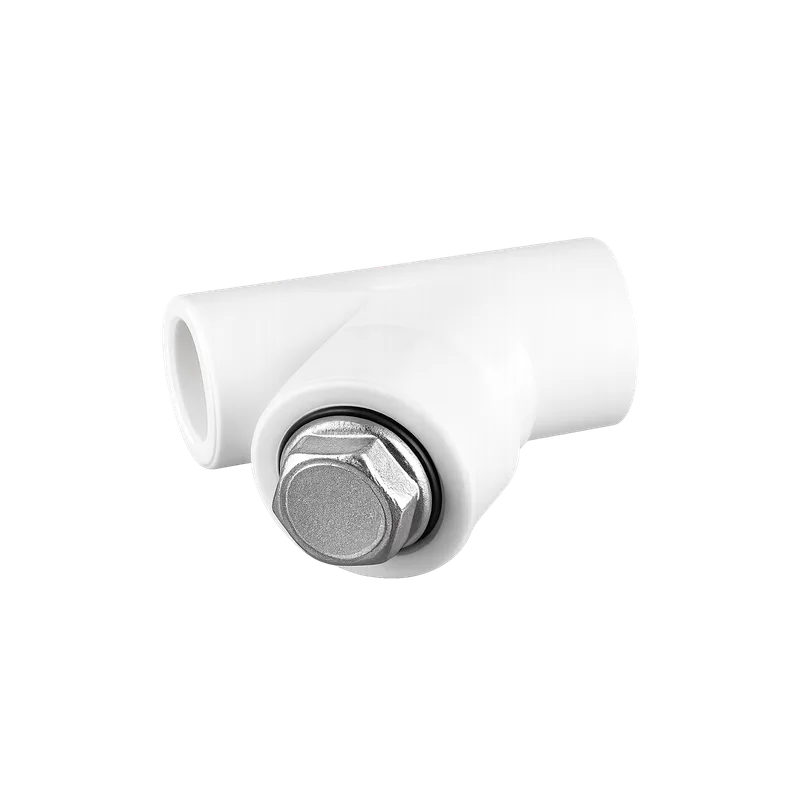
Description and application
The PPR filter 45° f/f is a PP-R strainer fitting with a stainless steel mesh that catches coarse dirt in hot and cold water and heating lines. It protects the valves, pumps and appliances downstream and is socket-fused onto PP-R pipe in sizes Ø20, Ø25 and Ø32.
The PPR filter 45° f/f is an in-line strainer for PP-R pipework from the Eternal line. A stainless steel mesh inside the body holds back coarse dirt such as sand, scale and installation debris. The dirt settles in the 45° leg, and during routine maintenance the blind cap is opened and the leg is cleaned. Installers also call this fitting a dirt trap. The body is made of PP-R, a polypropylene random copolymer (type 3), to EN ISO 15874-3. The fitting has nominal pressure PN25, an operating temperature of 70 °C and a maximum temperature of 95 °C. It has a brass insert made of CW617N, and the threaded brass parts use BSP parallel (gas) thread. It is supplied in white in Ø20, Ø25 and Ø32. The filter is used in domestic hot and cold water supply and in heating circuits. It is fitted upstream of the equipment it protects, such as pressure-reducing valves, water meters, pumps, boilers and mixing valves. Both ends are female sockets, so the fitting is joined straight onto the pipe by socket fusion with a standard PP-R welding tool, with no adaptors. It welds with THERMALINO PP-R pipes into one homogeneous joint. Fit the filter on a straight run with the strainer leg pointing downwards. Leave enough space around the cap for cleaning. Values that depend on temperature and service life are given in the technical data sheet.
- Domestic hot and cold water supply in houses and apartment buildings
- Central heating circuits, upstream of boilers, pumps and mixing valves
- Protection of water meters, pressure-reducing valves and solenoid valves
- Hotels, hospitals, schools and office buildings
- HVAC chilled and cooling water circuits
- Irrigation and agricultural water lines
- Industrial process water, subject to the chemical resistance table in the technical data sheet
Technical summary
- SKU
- THL-E-PPR-0041
- Origin
- Made in Türkiye
- HS code
- 3917.40
- Size range
- Ø20 – Ø32
- Material
- PP-R
- Nominal pressure
- PN25
- Operating temperature
- 70 °C
- Max. temperature
- 95 °C
- Connection
- Socket fusion
- Insert material
- Brass (CW617N)
- Standard
- EN ISO 15874-3
Questions
- What does a PPR filter do in a domestic water or central heating installation, and which parts of the system does it protect?
- A PPR filter catches sand, scale, rust and installation debris in a stainless steel mesh before they reach the equipment downstream. In a PP-R system it protects pressure-reducing valves, water meters, pumps, boilers, mixing valves and taps from wear and blockage. The dirt settles in the 45° leg, where it can be removed during maintenance.
- Can the PPR filter 45° be used on hot water and heating lines in a residential building, and what temperature does it handle?
- The PPR filter 45° f/f is suitable for both hot and cold water and for heating lines, because it is rated PN25. Its operating temperature is 70 °C and its maximum temperature is 95 °C. Allowable pressures at specific temperatures and service lives are given in the technical data sheet.
- How is a PPR filter joined to PP-R pipe, and which way should the 45° strainer leg point on a horizontal water line?
- A PPR filter is joined to PP-R pipe by socket fusion, because both of its ends are female sockets that take the pipe directly. On a horizontal liquid line, the strainer leg should point downwards so that dirt settles in the leg and stays out of the flow. Leave room around the blind cap for cleaning, and fit the filter upstream of the equipment it protects.
- How is the mesh of a PPR strainer cleaned during maintenance of a hot water or heating system?
- The mesh of a PPR strainer is cleaned by opening the blind cap on the 45° leg, removing the dirt that has settled there and refitting the cap. The system is under pressure and may hold hot water, so a qualified installer should isolate and depressurise the line before opening the cap. A drop in flow or pressure at taps or appliances downstream is a common sign that the mesh needs cleaning.
- Which pipe sizes does the PPR filter 45° f/f fit, and which standard do its PP-R parts follow?
- The PPR filter 45° f/f is available for Ø20, Ø25 and Ø32 PP-R pipe. Its PP-R body conforms to EN ISO 15874-3, the brass insert is CW617N, and the threaded brass parts use BSP parallel thread. It welds with THERMALINO PP-R pipes of the same size.
Range
| Size | White | Variant codes |
|---|---|---|
| Ø20✓ White | ✓ | |
| Ø25✓ White | ✓ | |
| Ø32✓ White | ✓ |
Request a quotation
Or by e-mail: [email protected]
This product is listed under PPR Fittings With Brass.
All products