
3-Layer PE-RT EVOH Barrier pipe
The EVOH oxygen barrier is the outermost of the three layers, so it keeps oxygen out of closed heating circuits to DIN 4726 only while the surface is intact. Protect the pipe from cuts, deep scratches and abrasion during storage and laying.
Images
Description and application
The 3-Layer PE-RT EVOH Barrier pipe is a PE-RT pipe for wet underfloor heating, with an outer EVOH layer that keeps oxygen out of the closed heating circuit. It is made to EN ISO 22391-2 and DIN 4726, and comes in long coils so that each heating loop can be laid in one piece from the manifold.
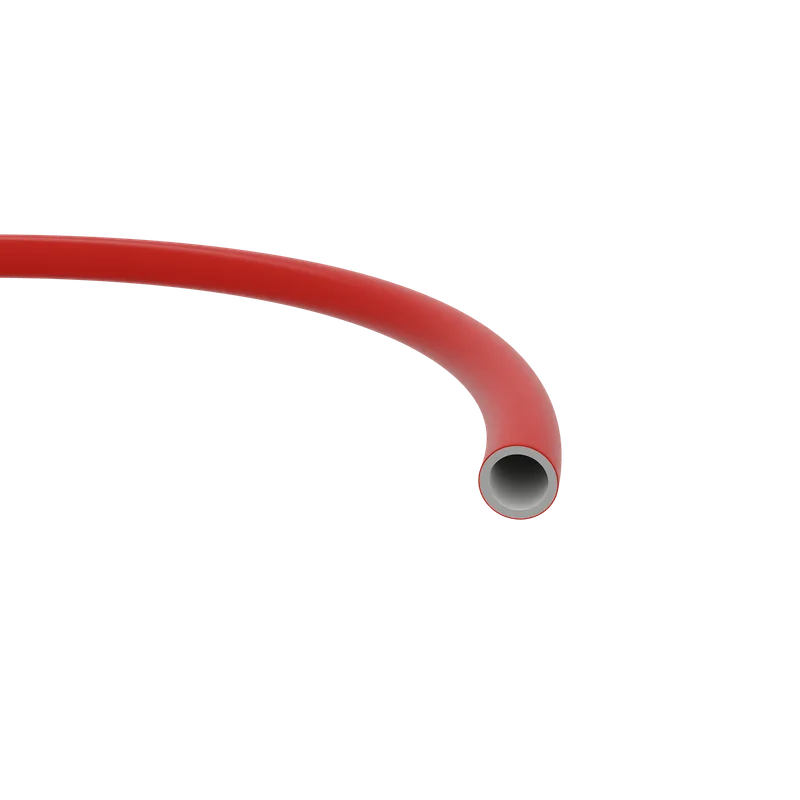
The 3-Layer PE-RT EVOH Barrier pipe from the THERMALINO Smart line is a PE-RT pipe for wet underfloor heating systems. PE-RT stands for polyethylene of raised temperature resistance. The pipe has three layers: the PE-RT base pipe, an adhesive layer and an outer EVOH oxygen barrier. It is made to EN ISO 22391-2 and DIN 4726. The EVOH layer limits the diffusion of oxygen through the pipe wall into the closed heating circuit. This protects the boiler, heat pump, circulating pump, manifold and other metal components connected to the system from oxygen corrosion. The maximum operating pressure is 8 bar and the maximum operating temperature is 70 °C. The pipe is rated for application classes 1, 2 and 5 at 8 bar and class 4 at 10 bar. Pressure ratings at other temperatures and service-life values are given in the technical data sheet. The pipe comes in red in four sizes, Ø16x2.0, Ø17x2.0, Ø20x2.0 and Ø25x2.3 mm, and each size is available in 200 m, 500 m and 600 m coils. With these coil lengths, each heating loop can run from the manifold through bends and turns in one piece. Joints are only needed at the connection points, so there are no fittings inside the screed. This underfloor heating pipe is laid without a protective sleeve. It can be fixed to insulation panels, clip rails or tacker systems and then covered with screed. At the underfloor heating manifold it is connected with fittings that match its outside diameter and wall thickness.
- Underfloor heating in houses and apartment buildings
- Underfloor heating in offices, hotels, schools and hospitals
- Low-temperature heating circuits with heat pumps and condensing boilers
- Wall heating, within the pipe's pressure and temperature limits
- Floor heating in industrial halls, warehouses and sports halls
- Floor heating in greenhouses and livestock buildings
Technical summary
- SKU
- THL-S-UFH-0003
- Origin
- Made in Türkiye
- Size range
- Ø16 – Ø25
- Material
- PE-RT
- Layers
- 3
- Oxygen barrier
- EVOH
- Application class
- Class 1/8 bar, Class 2/8 bar, Class 4/10 bar, Class 5/8 bar
- Max. operating pressure
- 8 bar
- Max. operating temperature
- 70 °C
- Standard
- EN ISO 22391-2 | DIN 4726
Questions
- What is a PE-RT pipe, and why is a 3-layer version with an EVOH barrier used for underfloor heating in homes?
- A PE-RT pipe is made from polyethylene of raised temperature resistance, and the 3-Layer PE-RT EVOH Barrier pipe adds an outer EVOH layer so it can be used in closed underfloor heating circuits. The three layers are the PE-RT base pipe, an adhesive layer and the EVOH oxygen barrier. The pipe is made to EN ISO 22391-2 and DIN 4726. Its maximum operating pressure is 8 bar and its maximum operating temperature is 70 °C.
- For an underfloor heating job in screed, should I choose PE-RT pipe or PEX pipe, and what is the real difference between them?
- Both PE-RT and PEX pipe are widely used for underfloor heating. The main difference is in the material: PEX is cross-linked, while PE-RT is not. PE-RT gets its temperature resistance from its molecular structure and stays a thermoplastic. The 3-Layer PE-RT EVOH Barrier pipe is rated for a maximum operating temperature of 70 °C and a maximum operating pressure of 8 bar, which covers the low flow temperatures of floor heating. For systems that run hotter than its limits, check the application classes and the pressure-temperature table in the technical data sheet before choosing a pipe.
- Is PE-RT pipe the same as HDPE pipe, or can a standard HDPE water pipe be used in an underfloor heating circuit?
- PE-RT pipe and standard HDPE pressure pipe are both polyethylene, but they are not the same. PE-RT is a polyethylene grade designed for raised temperatures in hot water and heating systems. Standard HDPE pipes are generally used for cold water and gas networks, not heating circuits. The 3-Layer PE-RT EVOH Barrier pipe is made to EN ISO 22391-2, the standard for PE-RT pipes in hot and cold water systems, and has an EVOH oxygen barrier to DIN 4726.
- Is PE-RT the same as polybutylene, and should it raise the same concerns when replacing old heating pipework in a house?
- PE-RT is not polybutylene. PE-RT is a polyethylene, while polybutylene (PB) is a different polymer that is made to a different standard, ISO 15876. The 3-Layer PE-RT EVOH Barrier pipe is made to EN ISO 22391-2 and DIN 4726. Any replacement of heating pipework should be planned and carried out by a qualified installer.
Range
| Size | Red | Variant codes |
|---|---|---|
| Ø16x2.0-L:200m✓ Red | ✓ | |
| Ø16x2.0-L:500m✓ Red | ✓ | |
| Ø16x2.0-L:600m✓ Red | ✓ | |
| Ø17x2.0-L:200m✓ Red | ✓ | |
| Ø17x2.0-L:500m✓ Red | ✓ | |
| Ø17x2.0-L:600m✓ Red | ✓ | |
| Ø20x2.0-L:200m✓ Red | ✓ | |
| Ø20x2.0-L:500m✓ Red | ✓ | |
| Ø20x2.0-L:600m✓ Red | ✓ | |
| Ø25x2.3-L:200m✓ Red | ✓ | |
| Ø25x2.3-L:500m✓ Red | ✓ | |
| Ø25x2.3-L:600m✓ Red | ✓ |
Request a quotation
Or by e-mail: [email protected]
This product is listed under PE-RT Pipes.
All products