
PEX-a EVOH Barrier Pipe
The pipe carries application Class 1, Class 2 and Class 4 at 10 bar and Class 5 at 8 bar to EN ISO 15875-2. These classes cover hot and cold water supply, underfloor heating and radiator circuits, within a maximum operating temperature of 80 °C. Service life values for each class are in the technical data sheet.
Images
Description and application
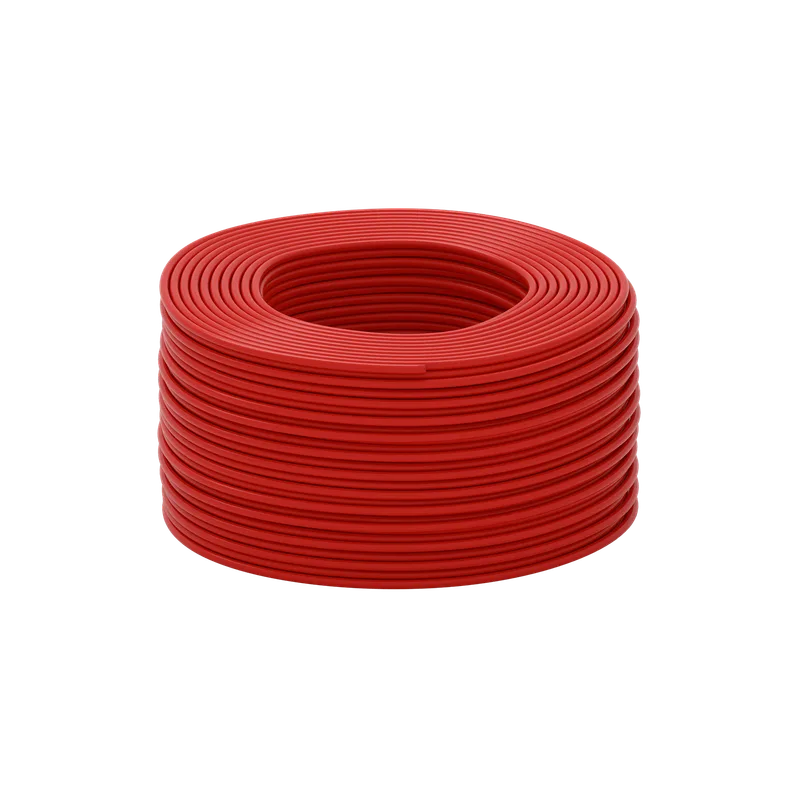
PEX-a EVOH barrier pipe is a three-layer PE-Xa pipe with an EVOH oxygen barrier to DIN 4726, made to EN ISO 15875-2 for underfloor heating, radiator circuits and hot and cold water lines up to 10 bar. It is supplied in red coils from Ø16x2.0 to Ø25x2.3 mm, in lengths of 200, 500 and 600 m.
The PEX-a EVOH barrier pipe of the Eternal line is a three-layer PEX pipe with a PE-Xa core and an EVOH oxygen barrier. The PE-Xa core is highly cross-linked. This keeps the pipe flexible when underfloor loops are laid and gives it the thermal memory that sliding-sleeve joints rely on. The EVOH layer limits oxygen diffusion into the system water as DIN 4726 requires, which protects boilers, pumps, radiators and other steel or cast-iron components from corrosion. The pipe is made to EN ISO 15875-2 and rated for application Class 1, Class 2 and Class 4 at 10 bar and Class 5 at 8 bar. The maximum operating pressure is 10 bar and the maximum operating temperature is 80 °C. Pressure and service life values for each class and temperature are in the technical data sheet. With these ratings it can be used in more than floor heating. It also suits radiator and wall heating circuits and heat pump and boiler systems, and it can serve as a barrier PEX pipe for hot and cold water supply where local approvals permit. It is supplied in red coils of 200, 500 and 600 m in Ø16x2.0, Ø17x2.0, Ø20x2.0 and Ø25x2.3 mm. The pipe can be joined with fittings made for PEX and PE-RT pipe: push-fit, press, compression and axial sliding-sleeve fittings. The fitting must match both the outside diameter and the wall thickness (pipe series) of the pipe. Where the fitting manufacturer approves it, axial sliding-sleeve joints can be embedded in the screed. During the first installation, a faulty joint of this type can be released by warming the pipe and then remade.
- Underfloor heating and cooling in homes, offices, hotels, schools and hospitals
- Radiator connections and wall heating circuits
- Heat pump and condensing boiler heating systems
- Supply and return lines between boilers, manifolds and fan coils
- Hot and cold water supply, subject to local drinking water approvals
- Industrial floor heating in warehouses, workshops and garages
- Greenhouse and livestock building heating
- Snow and ice melting in ramps and walkways, with an antifreeze approved for the pipe
Technical summary
- SKU
- THL-E-UFH-0005
- Origin
- Made in Türkiye
- Size range
- Ø16 – Ø25
- Material
- PE-Xa
- Layers
- 3
- Oxygen barrier
- EVOH
- Application class
- Class 1/10 bar, Class 2/10 bar, Class 4/10 bar, Class 5/8 bar
- Max. operating pressure
- 10 bar
- Max. operating temperature
- 80 °C
- Standard
- EN ISO 15875-2 | DIN 4726
Questions
- Do I need oxygen barrier PEX for underfloor heating connected to a boiler with steel or cast-iron components?
- Yes, a closed underfloor heating circuit should use an oxygen barrier pipe such as the PEX-a EVOH barrier pipe, because oxygen diffusing through a plain plastic pipe wall corrodes boilers, pumps and radiators and produces sludge. The EVOH layer of this pipe limits oxygen diffusion as DIN 4726 requires, so the pipe can be connected to systems that contain ferrous components.
- Can PEX-a EVOH pipe be used for hydronic radiator heating as well as underfloor heating in the same building?
- Yes, the PEX-a EVOH pipe can be used for both underfloor heating and radiator circuits. Under EN ISO 15875-2 it is rated Class 4 at 10 bar for underfloor heating and low-temperature radiators, and Class 5 at 8 bar for radiator heating. The maximum operating temperature is 80 °C, so the boiler or heat pump flow temperature must be set within this limit.
- How hot is too hot for a PEX-a EVOH pipe carrying heating water from a gas boiler or a heat pump?
- The PEX-a EVOH pipe has a maximum operating temperature of 80 °C and a maximum operating pressure of 10 bar, so a flow temperature above 80 °C is too hot for it. Running it continuously close to its limits shortens its service life. The technical data sheet lists the permitted pressure and service life for each temperature. Underfloor circuits fed from a high-temperature boiler need a mixing valve or temperature limiter, fitted by a qualified installer.
- Which fittings can be used with PEX-a EVOH pipe in a 16x2.0 or 25x2.3 heating installation, and can joints go under screed?
- PEX-a EVOH pipe can be joined with push-fit, press, compression or axial sliding-sleeve fittings made for PEX and PE-RT pipe, as long as each fitting matches both the outside diameter and the wall thickness of the pipe. A fitting sized for a different pipe series is a common cause of leaking joints. Where the fitting manufacturer approves it, axial sliding-sleeve joints can be embedded in the screed.
- What does PEX-a mean in a PEX-a EVOH heating pipe, and how is it different from other PEX pipe types?
- PEX-a EVOH pipe is cross-linked polyethylene made by the PE-Xa method, in which the polyethylene is cross-linked during extrusion, and it has an added EVOH oxygen barrier layer. The PE-Xa method gives a high degree of cross-linking. This makes the pipe flexible, and its thermal memory allows sliding-sleeve fittings to be used. PEX-b and PEX-c pipes are cross-linked by other methods, and plain PEX pipe without a barrier is not intended for closed heating circuits with ferrous parts.
- Is a small pressure drop normal when testing a PEX-a EVOH underfloor heating circuit before the screed is laid?
- A small initial pressure drop is normal when testing a PEX-a EVOH underfloor heating circuit, because plastic pipe expands slightly under test pressure and the water temperature settles. After the stabilisation period the pressure should hold steady. A drop that continues after stabilisation points to a leak at a joint or damage to the pipe. The test should be carried out by a qualified installer and the circuit kept under pressure while the screed is laid.
Range
| Size | Red | Variant codes |
|---|---|---|
| Ø16x2.0-L:200m✓ Red | ✓ | |
| Ø16x2.0-L:500m✓ Red | ✓ | |
| Ø16x2.0-L:600m✓ Red | ✓ | |
| Ø17x2.0-L:200m✓ Red | ✓ | |
| Ø17x2.0-L:500m✓ Red | ✓ | |
| Ø17x2.0-L:600m✓ Red | ✓ | |
| Ø20x2.0-L:200m✓ Red | ✓ | |
| Ø20x2.0-L:500m✓ Red | ✓ | |
| Ø20x2.0-L:600m✓ Red | ✓ | |
| Ø25x2.3-L:200m✓ Red | ✓ | |
| Ø25x2.3-L:500m✓ Red | ✓ | |
| Ø25x2.3-L:600m✓ Red | ✓ |
Request a quotation
Or by e-mail: [email protected]
This product is listed under PEX-a Pipes.
All products